 ethos
ethos
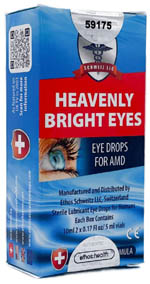
Ethos Bright Eyes NAC Eye Drops for AMD
Gentle, nourishing Swiss Ethos Heavenly AMD eye drops are formulated to support, comfort and moisture eyes as you get older — specifically designed to complement your daily routine for Age-related macular degeneration sufferers
Order Bright Eyes Drops for AMD
Age-related macular degeneration (AMD) is a condition many people become more aware of as they age. Ethos AMD eye drops are formulated to offer a gentle addition to your eye care routine and comfort for tired or dry eyes as part of a daily routine to improve vision.
More Information
Common Symptoms of AMD
- Straight lines or objects appearing bent or wavy
- A dark or blurry patch appearing in the centre of your vision
- Colours appearing less vivid, or objects changing shape when covering one eye
- Increasing difficulty with reading, writing, driving, watching TV, or using a computer
If you notice any of these symptoms, particularly a sudden change, please contact your optician or eye doctor promptly — early diagnosis makes a real difference to treatment outcomes.
Ingredients
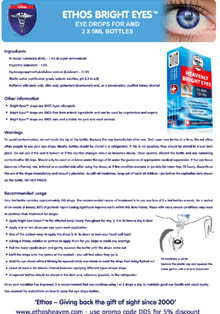
Bright Eyes NAC Eye Drops for AMD contain:
- Antioxidants: N-Acetyl-Carnosine (NAC) – 1.0%
- Glycerin (lubricant) – 1.0%
- Hydroxypropylmethylcellulose sodium (lubricant) – 0.15%
- Sterile water (ophthalmic grade isotonic solution, pH 6.3 to 6.5)
- Boric acid, citric acid, and potassium bicarbonate
- Purified benzyl alcohol (preservative)
Recommended Usage
Ethos eye drops generally fine to use alongside other prescribed eye medication — just leave at least a 30-minute interval between applying different drops, and check with your optician if you're ever unsure.
We suggest applying 1 drop to each eye, a few times a day as needed, as part of your daily comfort routine. If you've been diagnosed with AMD, please continue following your ophthalmologist's monitoring and treatment plan exactly as prescribed — this is especially important with wet AMD, where prompt treatment such as anti-VEGF injections is the standard, evidence-based way to control abnormal blood vessel growth and protect your remaining vision.
Lifestyle Support for AMD Sufferers
A number of lifestyle factors are genuinely linked to AMD risk and progression, and are worth discussing with your eye doctor alongside your treatment plan:
- Stopping or reducing smoking — one of the strongest known risk factors for AMD progression
- Regular exercise to support healthy circulation
- Wearing sunglasses outdoors to help block harmful UV rays
- Limiting high-fat and saturated-fat foods
- Keeping alcohol within the government-recommended daily limits, or avoiding it
- Speaking with your doctor about whether AREDS2-type nutritional supplementation (lutein, zeaxanthin, vitamins C and E, zinc, and copper) is appropriate for your stage of AMD
Specification Sheet
Mouseover for larger view

About Bright Eyes Drops for AMD
What's in our Ethos AMD Drops
Ethos Bright Eyes AMD eye drops is one of our most advanced eye formulations, containing lubricants, vitamins, and N-Acetyl-Carnosine (NAC), an antioxidant compound. It's formulated for daily use by those managing AMD, designed to help keep eyes comfortable and lubricated as part of your everyday routine.
Supporting Your Eyes as You Age
Nourishing your eyes with antioxidants and lubrication is a small but welcome part of caring for your vision as you get older. Alongside using Bright Eyes, a healthy diet plays a genuine, evidence-backed role in eye health — the U.S. National Eye Institute's AREDS2 study found that a specific combination of nutrients (vitamin C, vitamin E, zinc, copper, lutein, and zeaxanthin) reduced the risk of progression from intermediate to advanced AMD by around 25% in people with intermediate-stage disease. It's worth asking your eye doctor whether this kind of targeted nutritional support could be appropriate for you.
Understanding AMD
Age-related macular degeneration is a generally painless condition that affects central vision, usually in both eyes over time. Central vision — what you see when looking straight ahead — becomes blurred, which can make reading, recognizing faces, and driving increasingly difficult, even though side (peripheral) vision is typically unaffected. For some people, AMD progresses very slowly and has little day-to-day impact; for others, it advances more quickly and can significantly affect daily life.
AMD is a leading cause of vision loss among adults in their 60s and older — in the United States alone, nearly 20 million adults live with some form of the condition. While wet AMD accounts for only around 10% of cases, it's responsible for roughly 90% of the severe vision loss associated with the disease, which is why prompt diagnosis and treatment matter so much if you notice any sudden changes in your vision.